 NonGNU-devel ELPA: au-themes
au-themes 
- Description
- Sensory-safe themes for autism and neurodivergence
- Latest
- au-themes-0.4.0.0.20261119.2.tar (.sig), 2026-Nov-20, 680 KiB
- Maintainer
- Szymon Wilczek <swilczek.lx@gmail.com>
- Other versions:
- release version
- Website
- https://github.com/szymonwilczek/au-themes
- ELPA's Repository
- CGit or Gitweb
- All Dependencies
- modus-themes (.tar)
To install this package from Emacs, use package-install or list-packages.
Full description



Screenshots of every theme in code, Magit, Dired and Org
Go to the light or the dark themes, installation, usage or the list of families.
Calm, low-glare colour themes. Made first of all for autistic people, and for anyone who finds most themes too loud to read for long.
The name comes from Au, the chemical symbol for gold. Many autistic people use gold as the symbol of autism acceptance, in place of the blue puzzle piece.
Screenshots
Click a picture to open it in full size, or a name to see that theme in code, Magit, Dired and Org on the blog.
Light themes
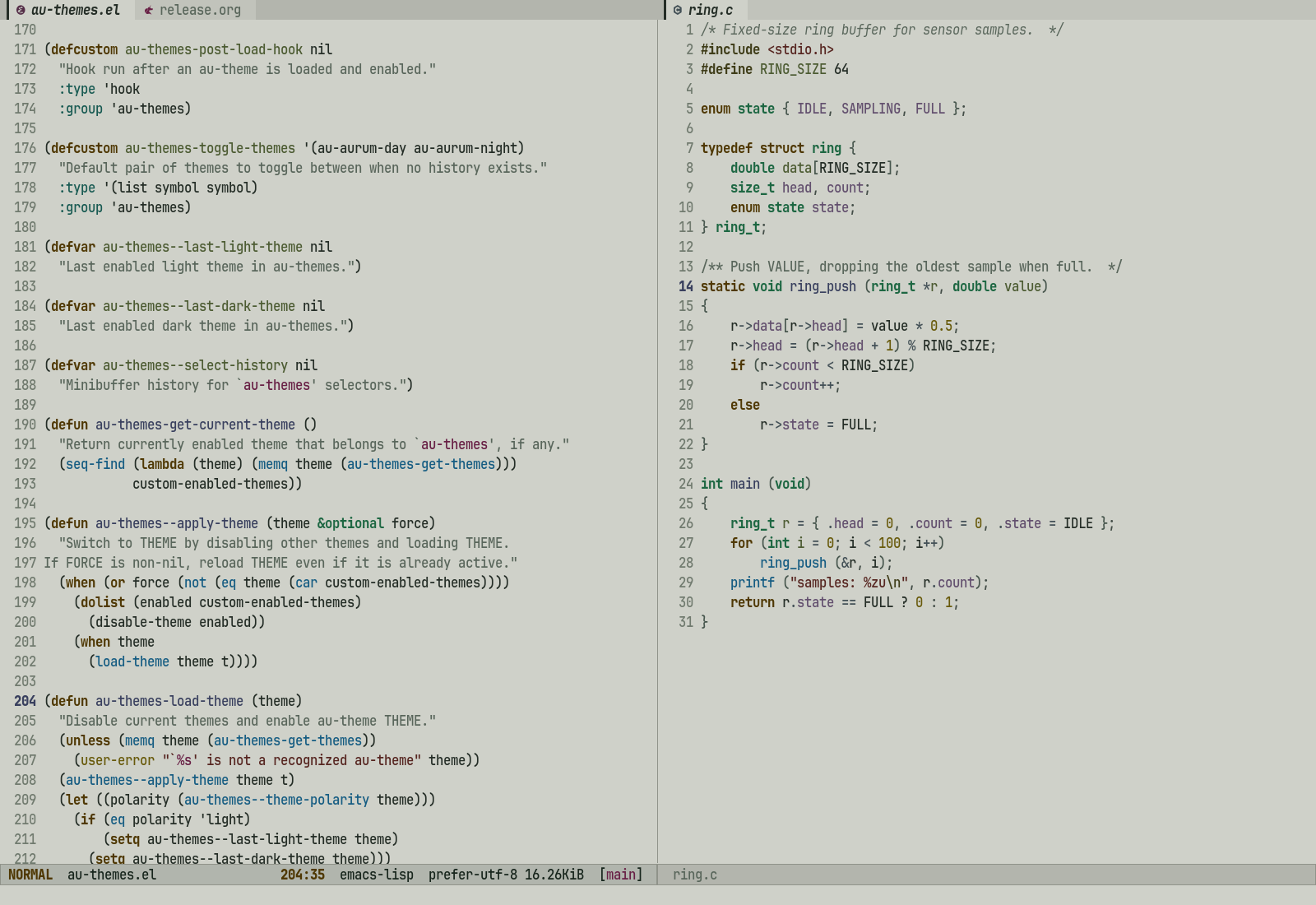
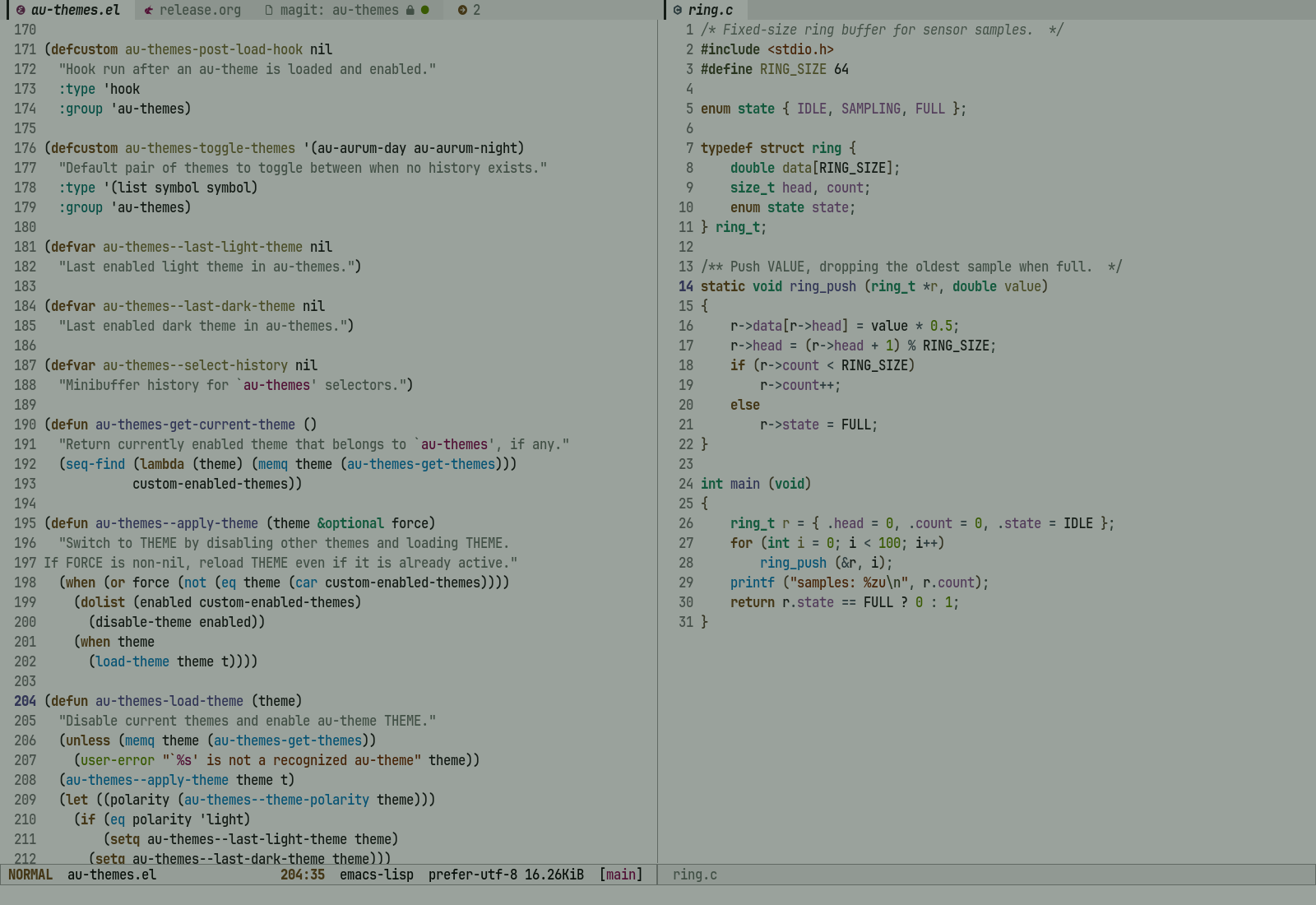
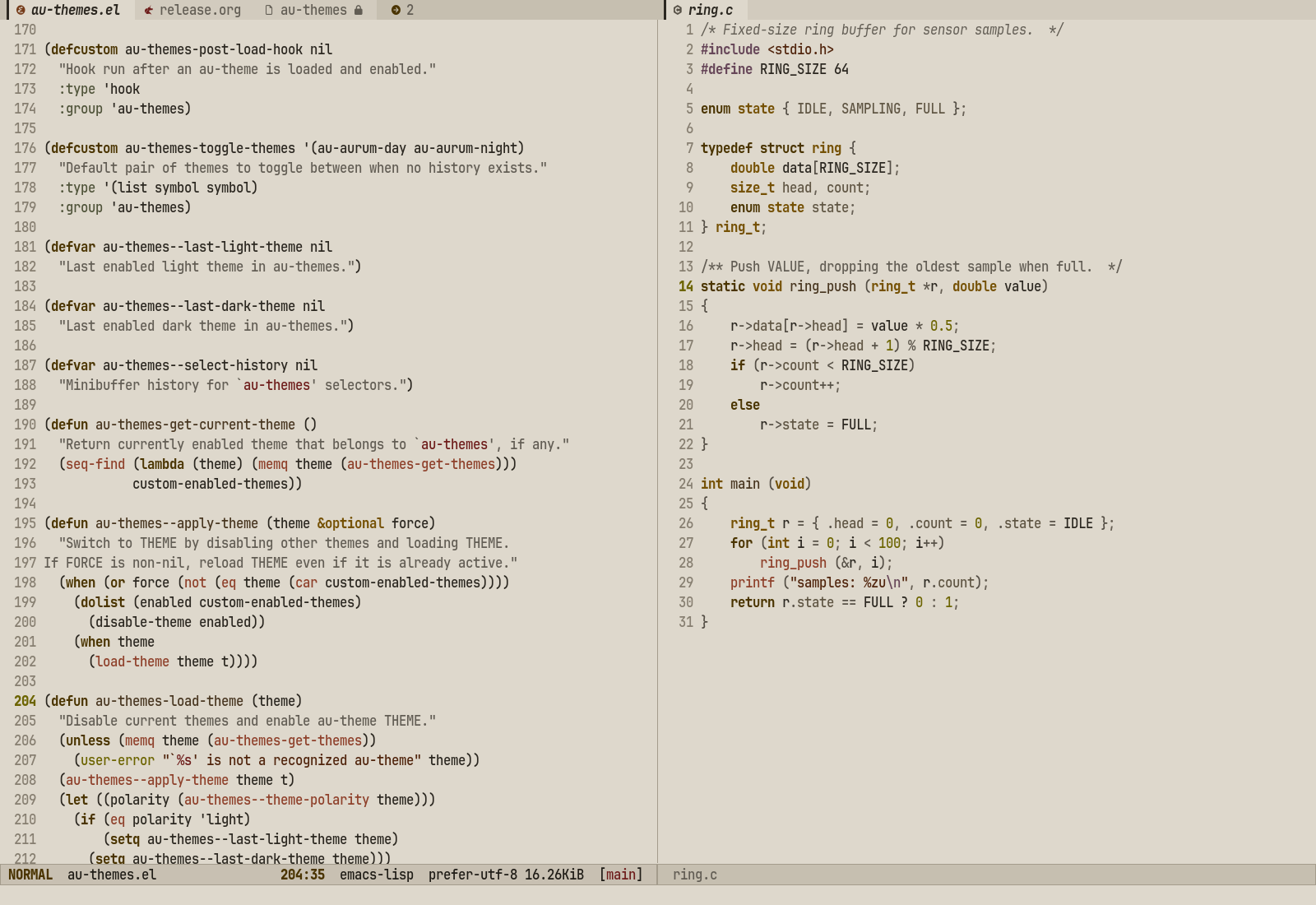
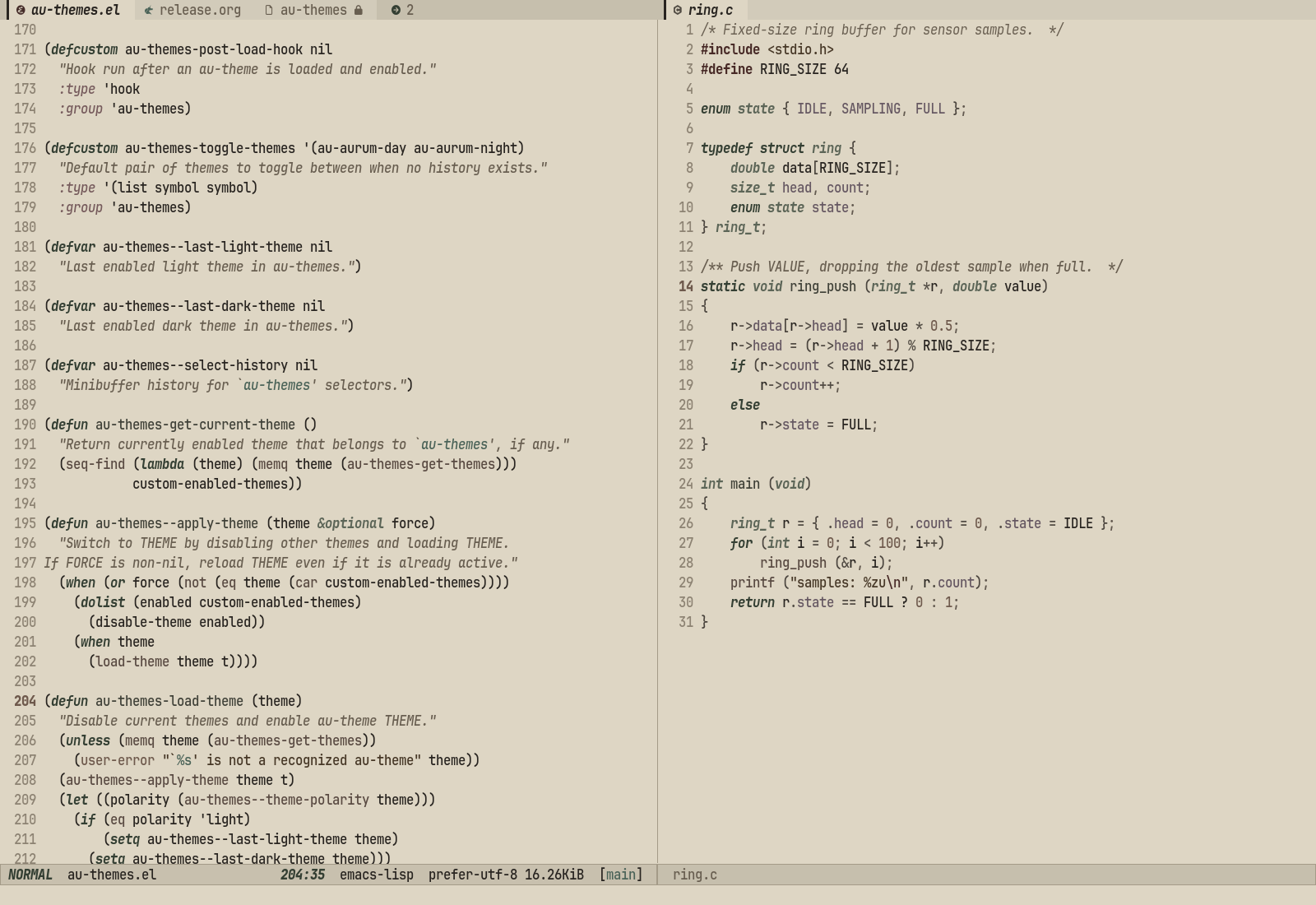
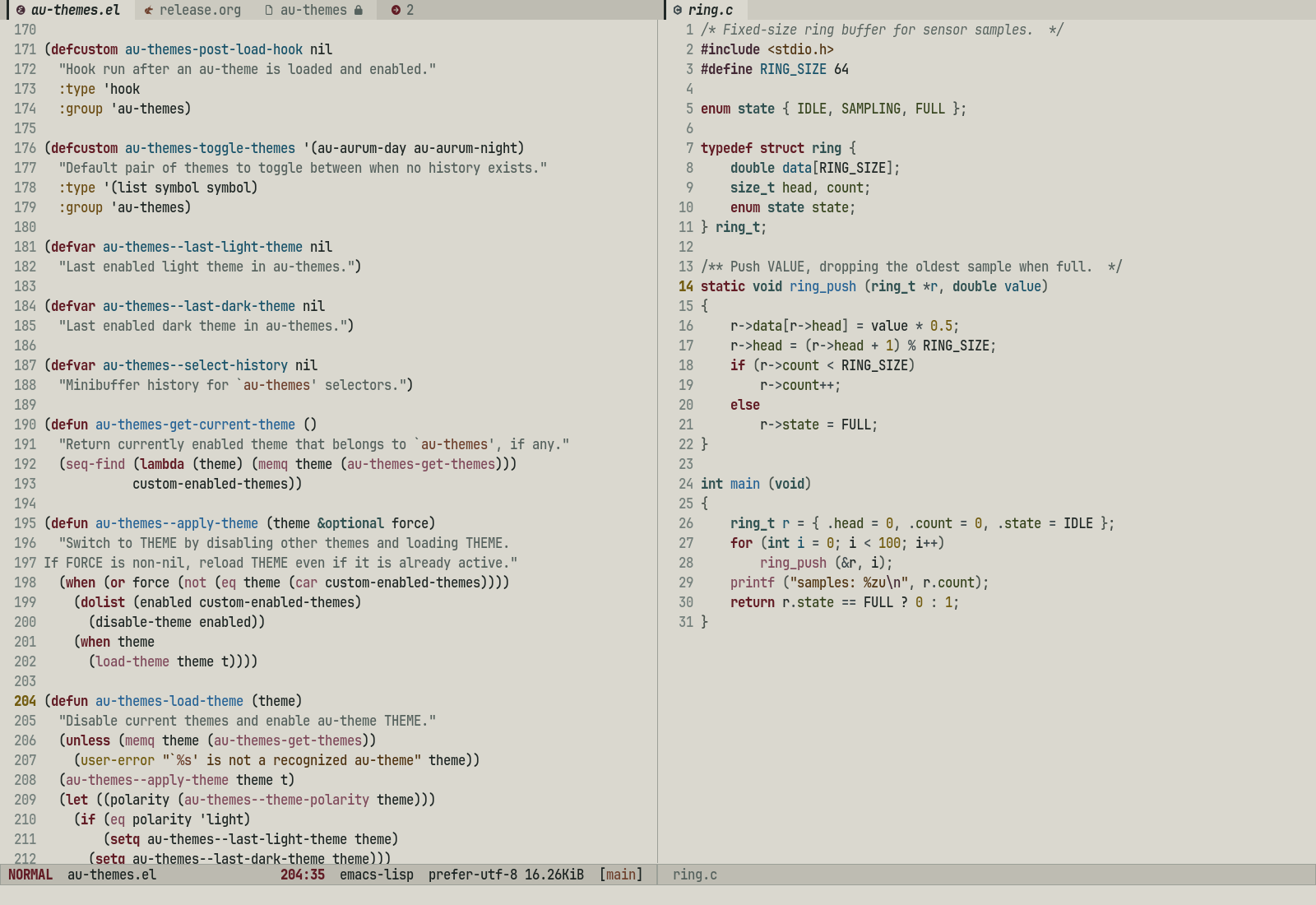
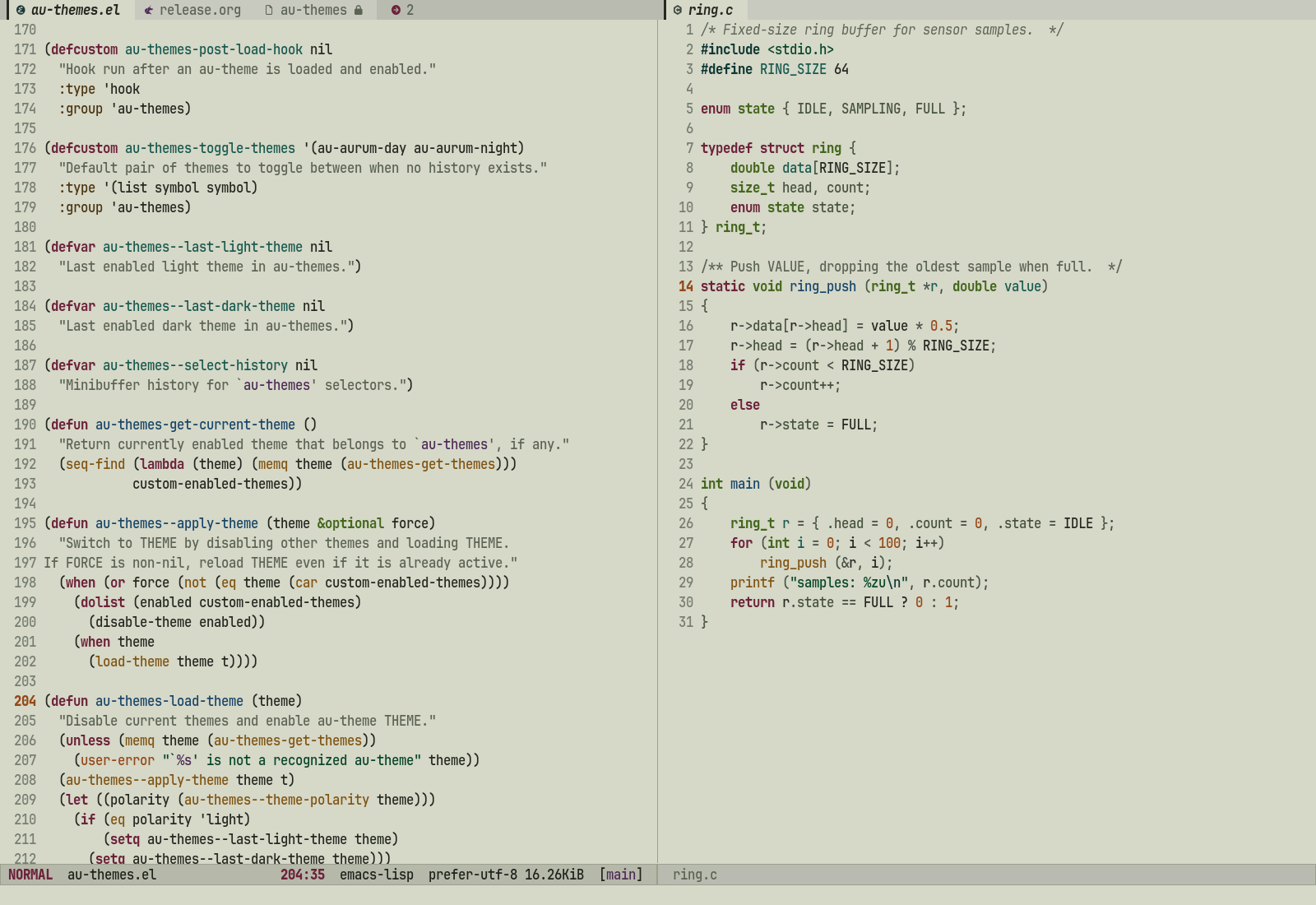
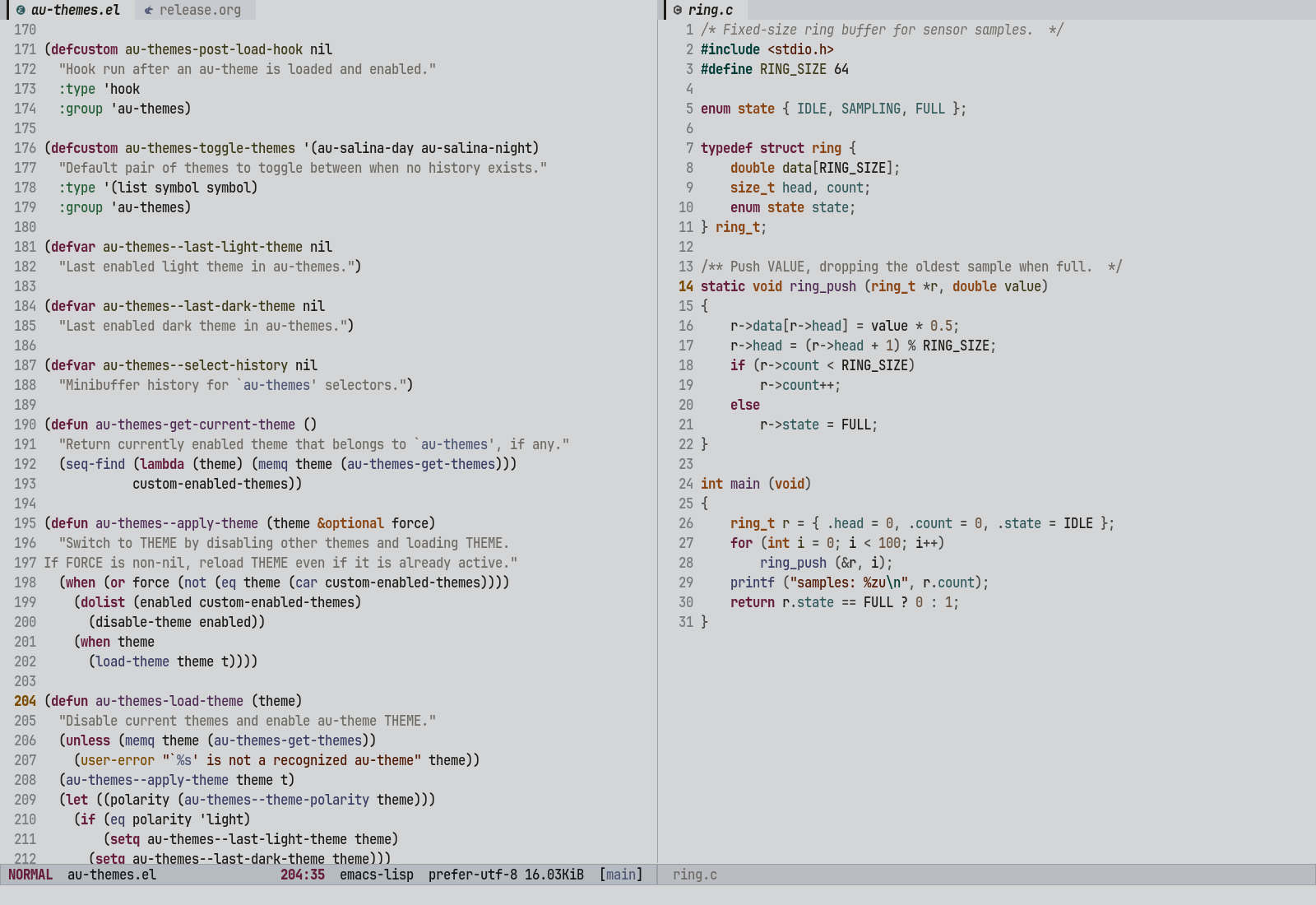
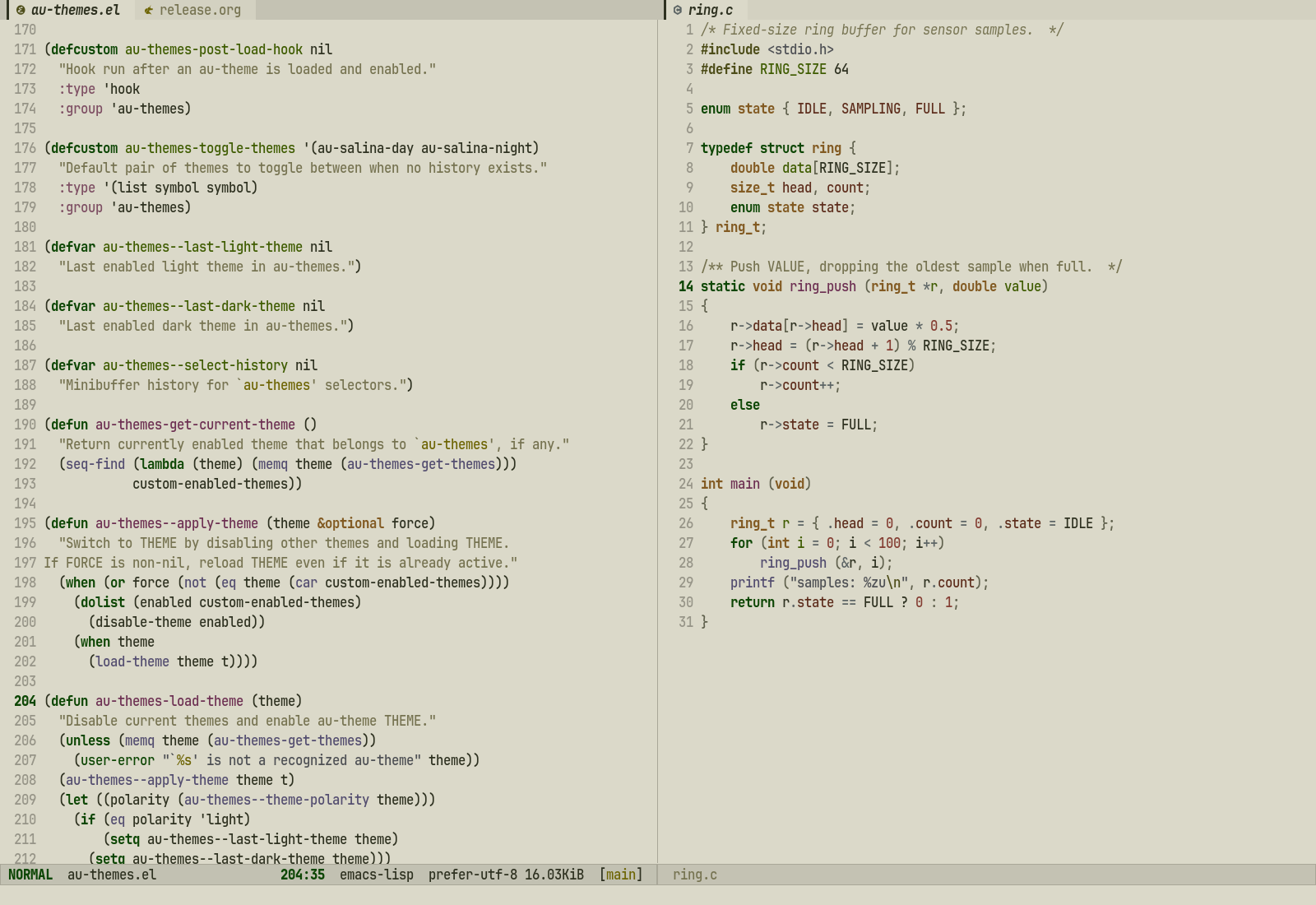
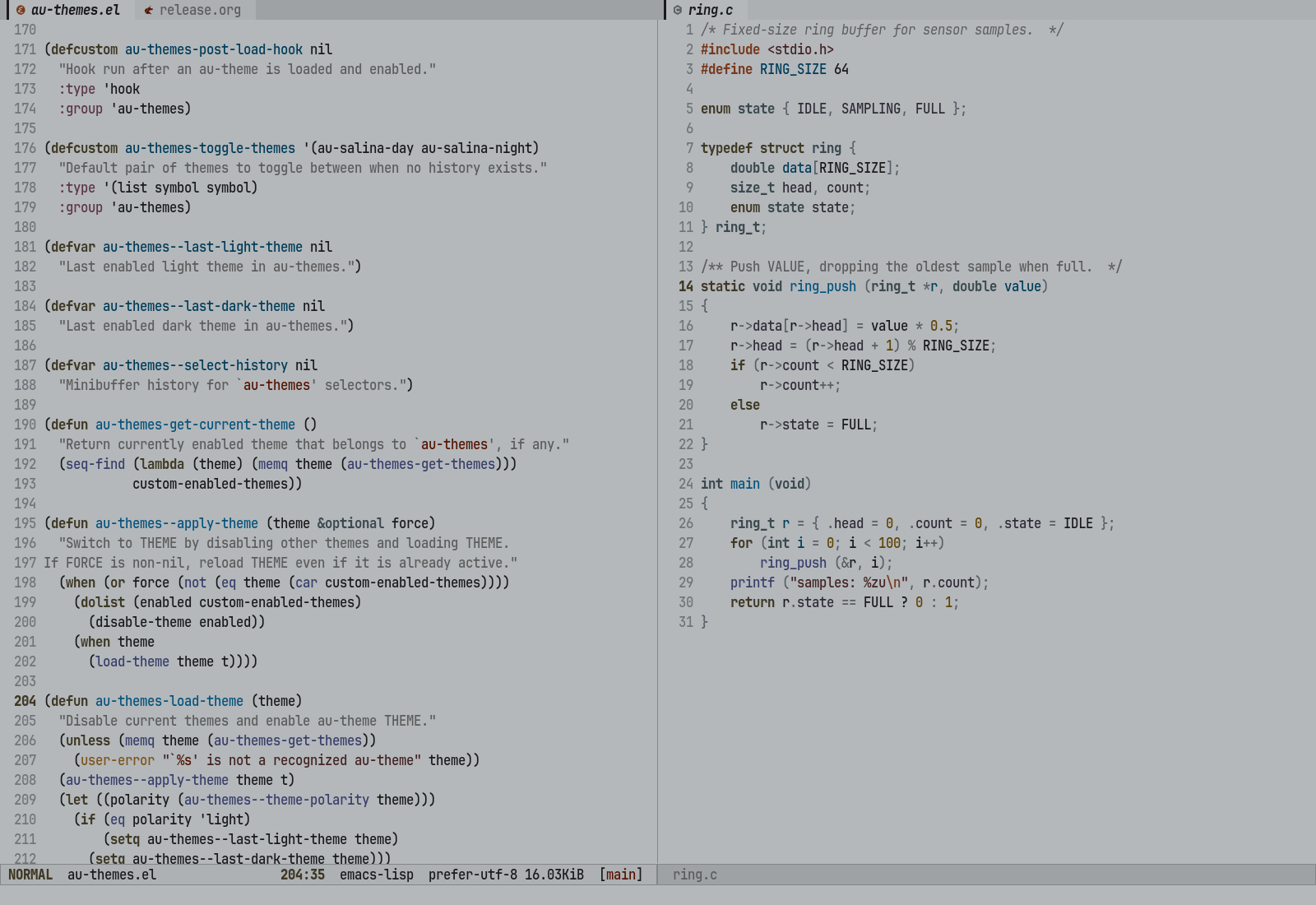
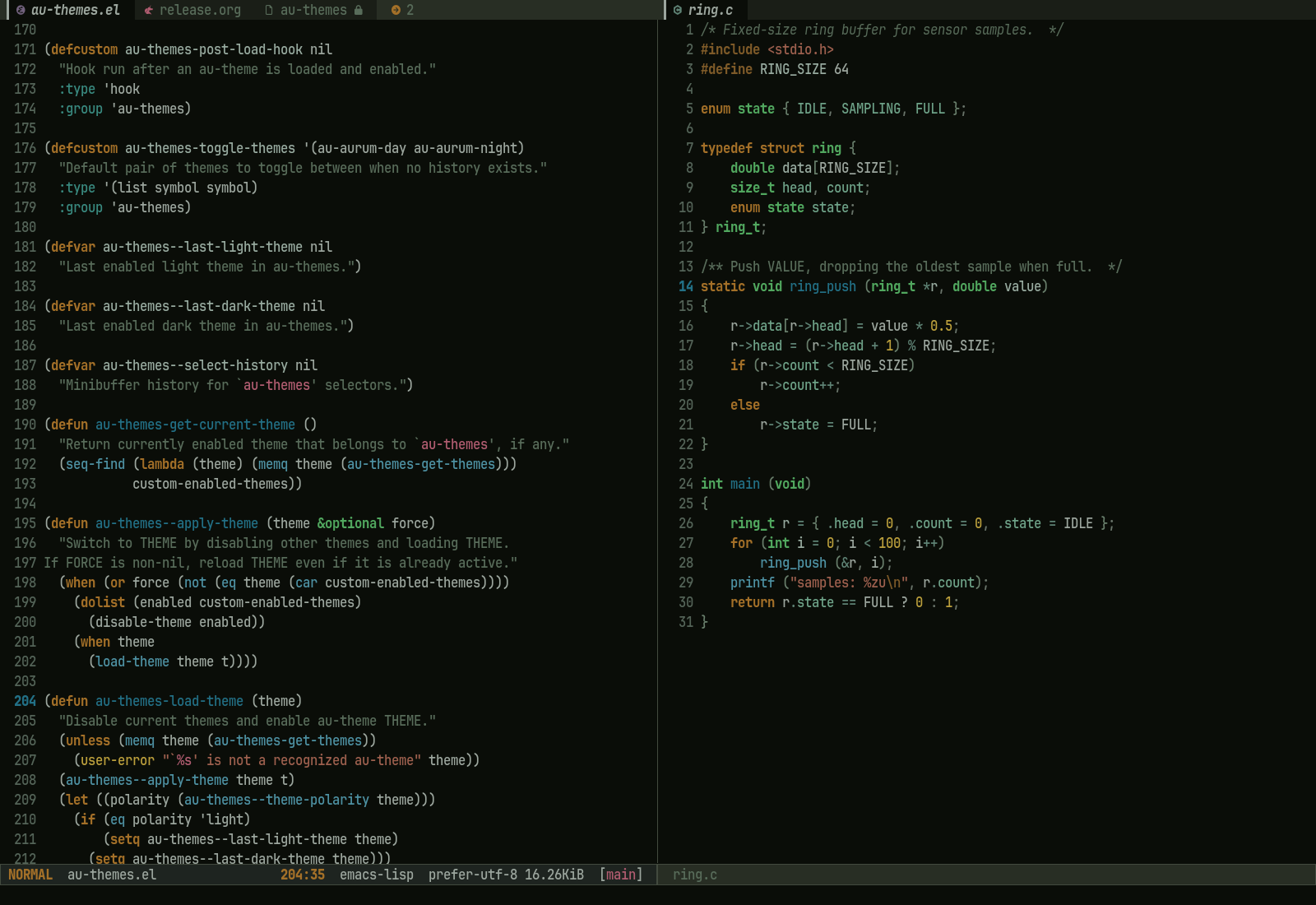
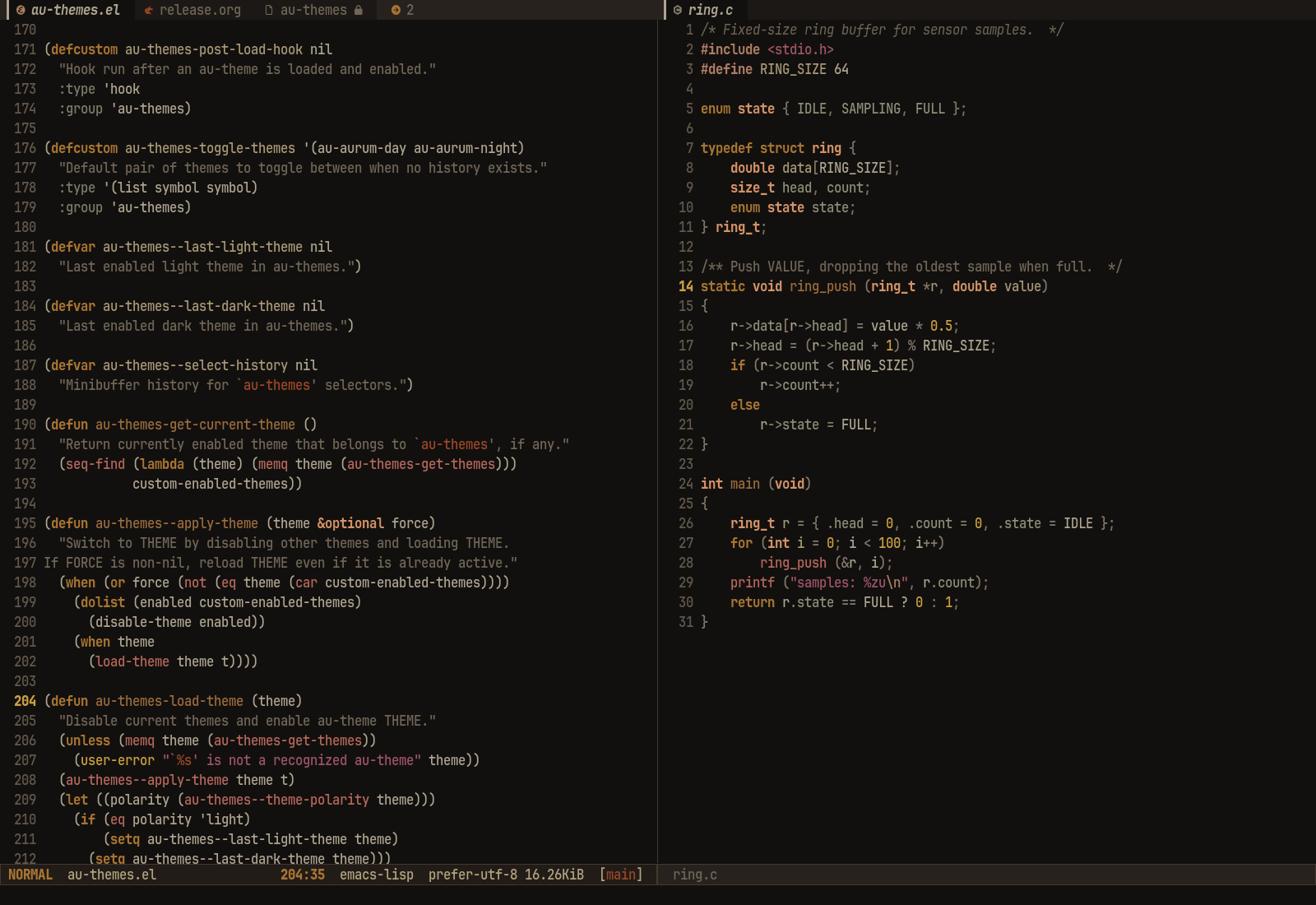
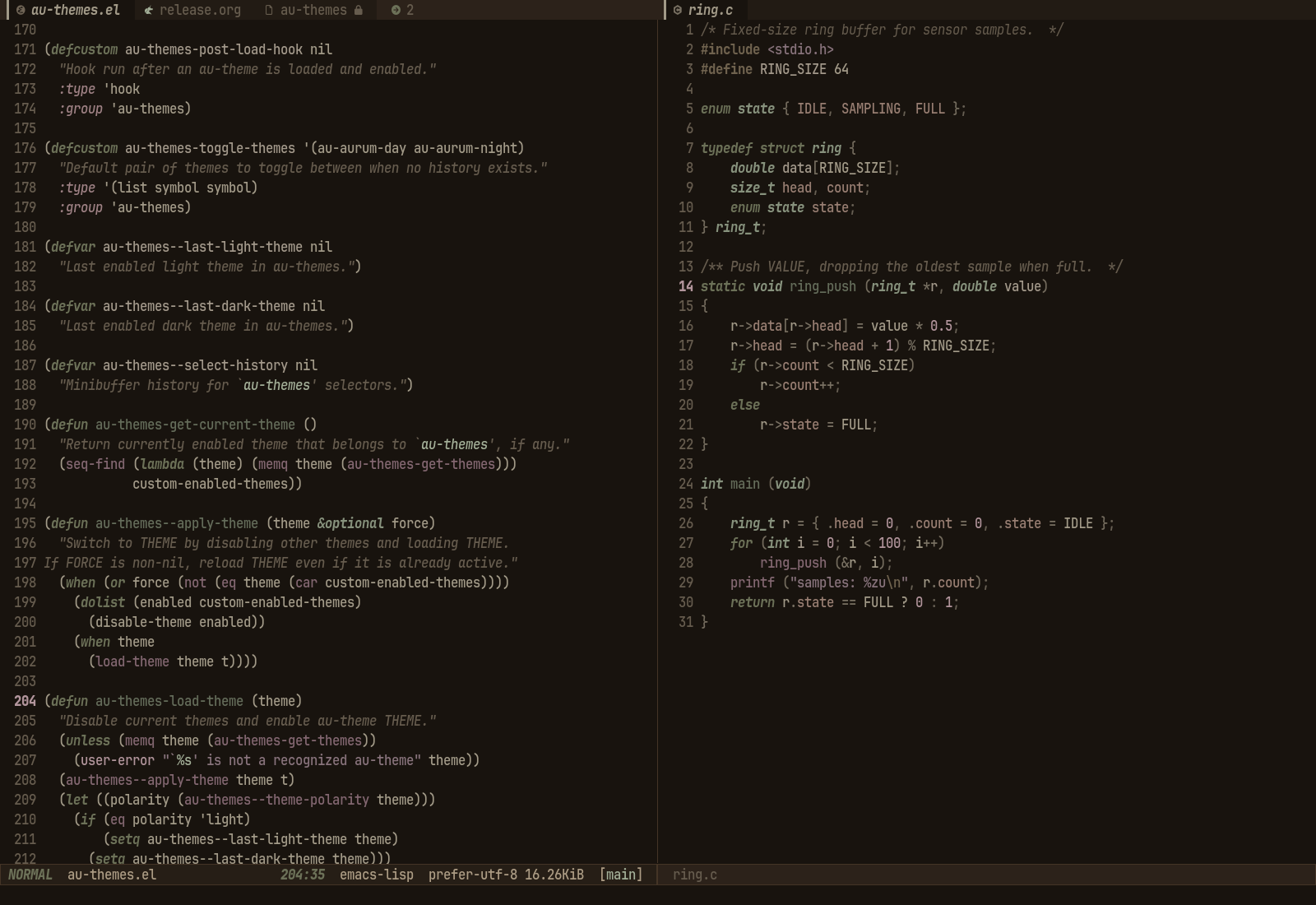
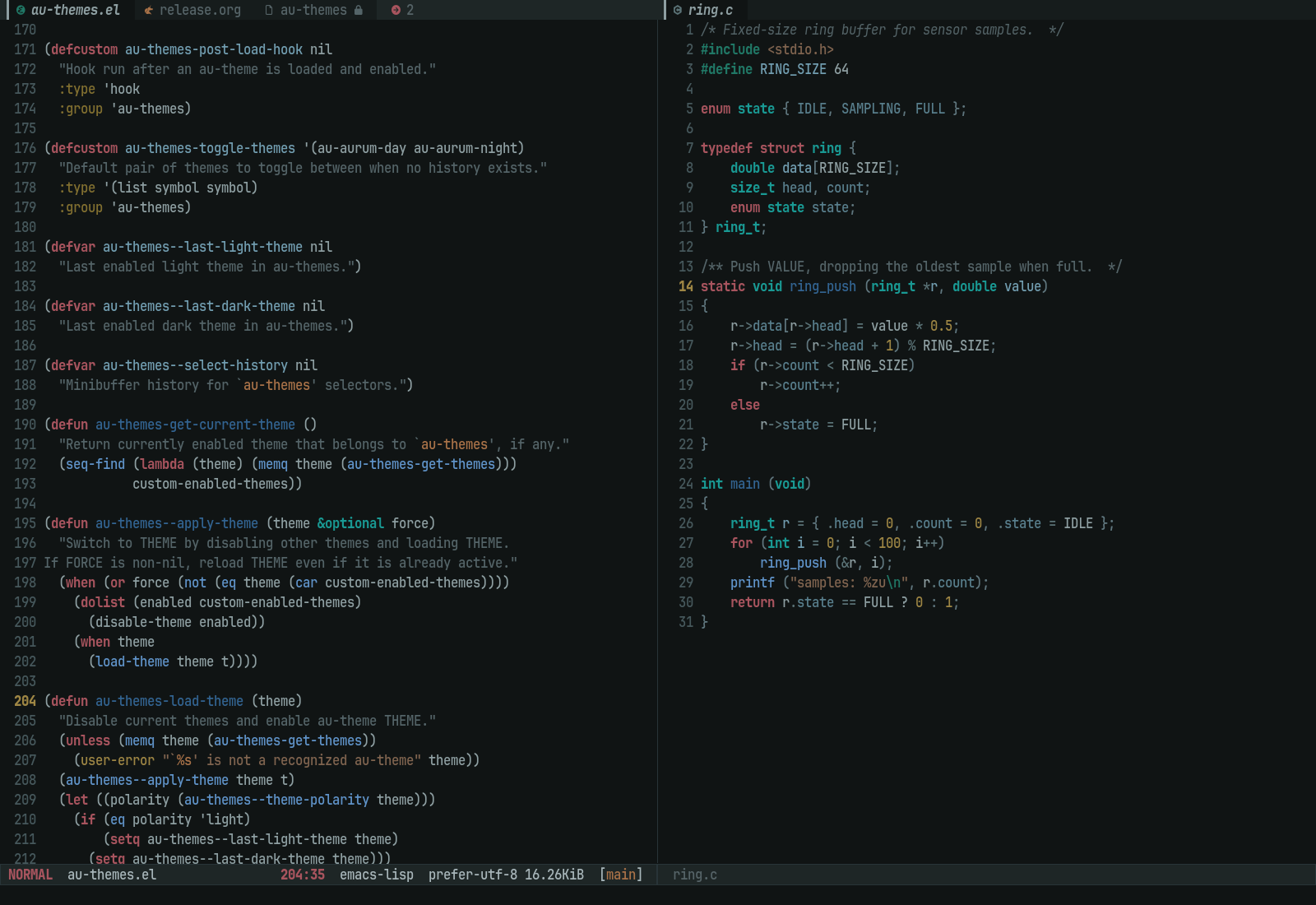
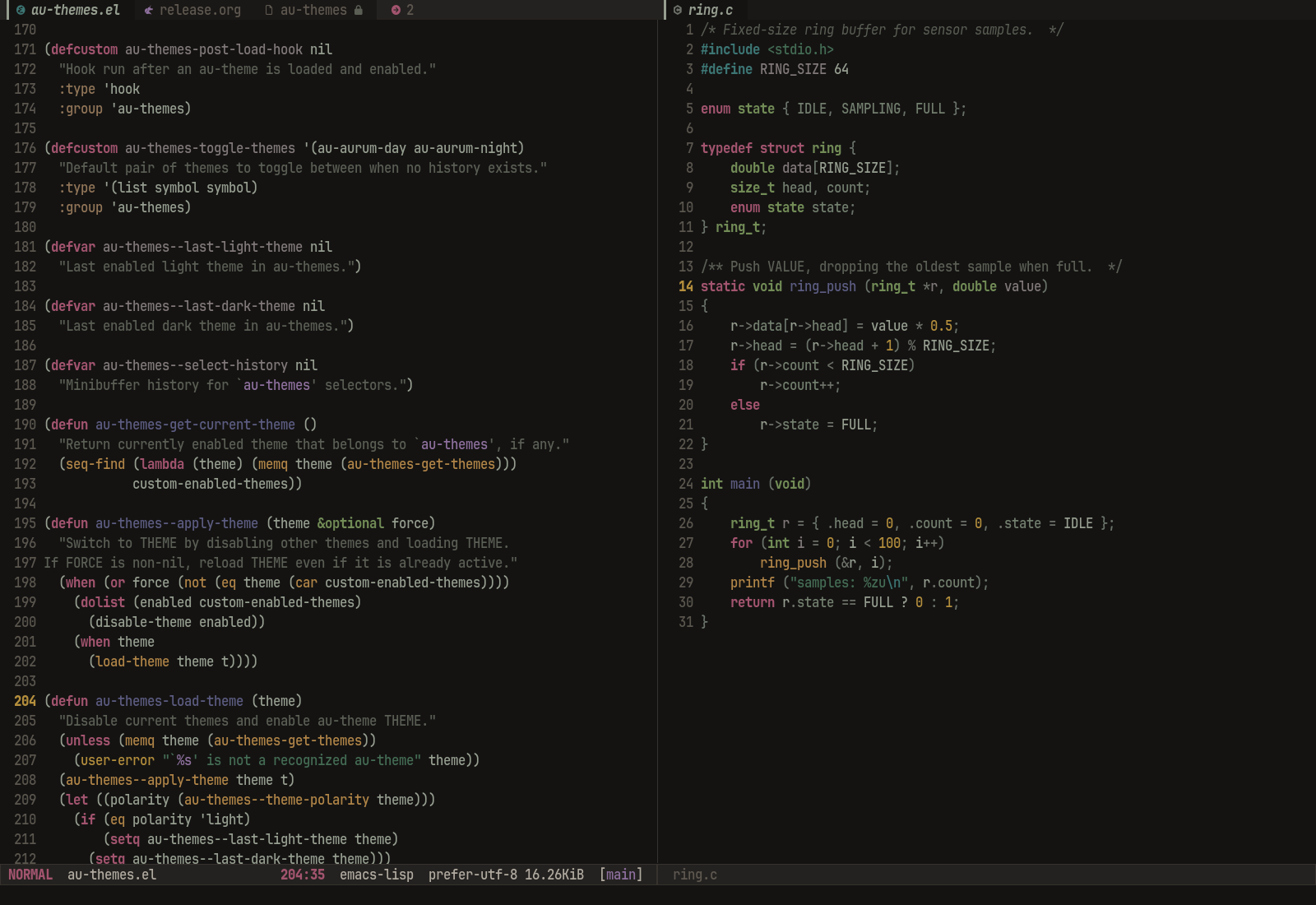
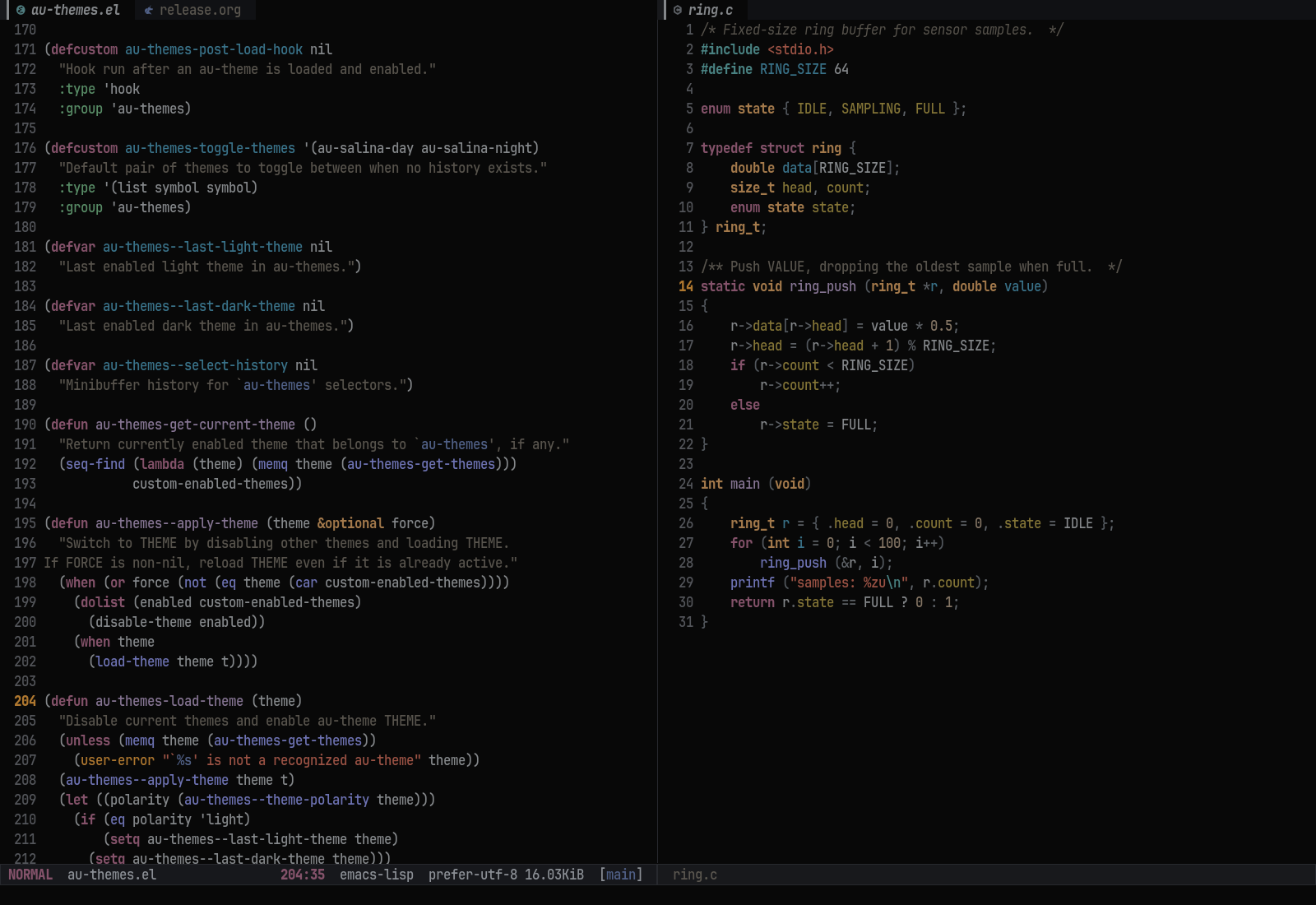
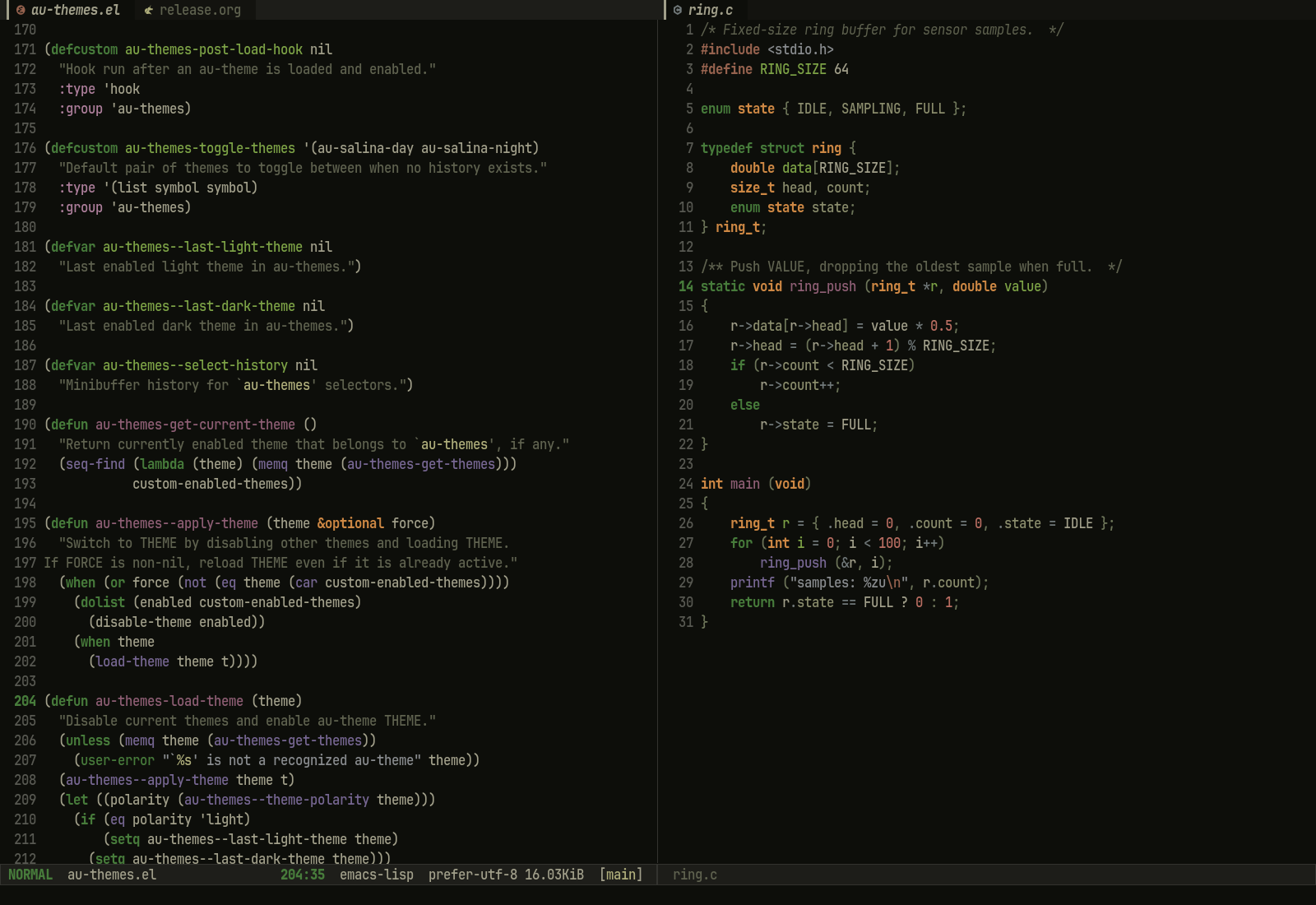
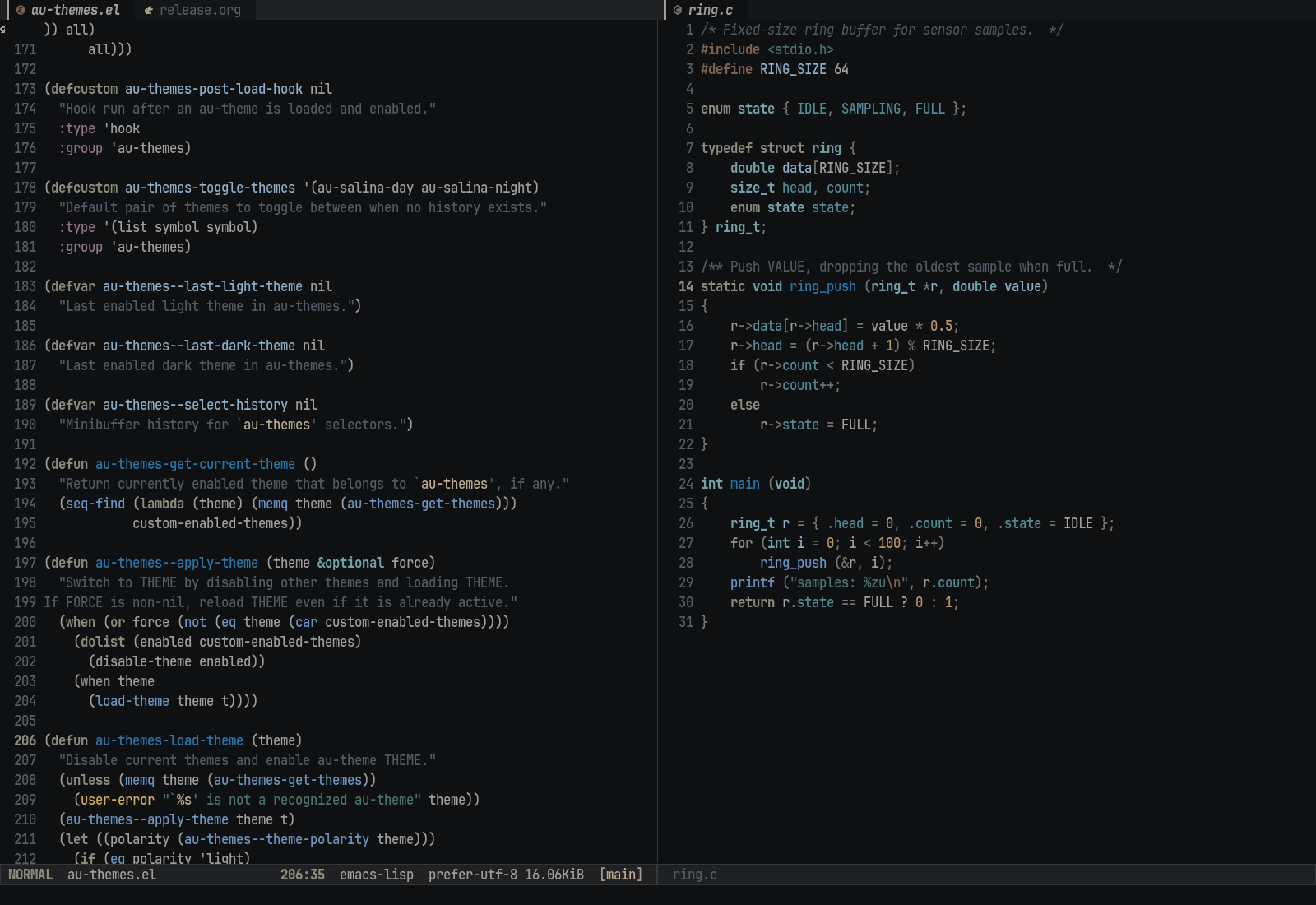
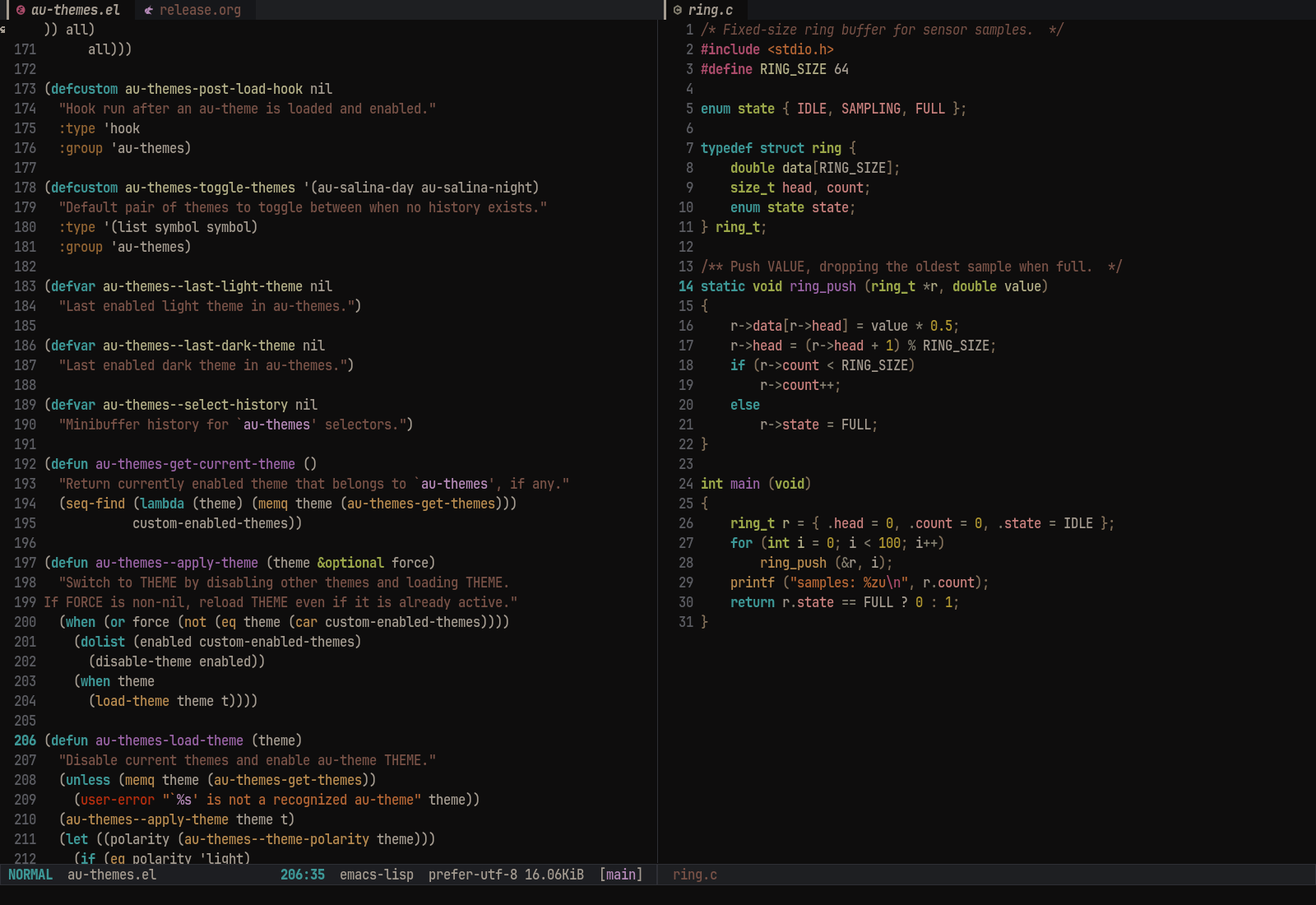
Emacs
Requirements
- Emacs 29.1 or newer
- modus-themes 5.2.0 or newer
The Emacs themes are built on top of modus-themes by Protesilaos Stavrou, and their shared semantic mappings come from his ef-themes. His work gives us face coverage for hundreds of packages and a solid base to build palettes on. Thank you, Prot.
Installation
au-themes is available on NonGNU ELPA, which is enabled by default
starting with Emacs 28.1.
Install it with:
M-x package-install RET au-themes RET
Or in your configuration:
(use-package au-themes
  :ensure t
  :config
  (load-theme 'au-salina-night t))
From source
You can also clone the repository manually:
git clone https://github.com/szymonwilczek/au-themes.git ~/.emacs.d/au-themes
(add-to-list 'load-path "~/.emacs.d/au-themes")
(require 'au-themes)
(load-theme 'au-salina-night t)
Or with package-vc-install on Emacs 30 or newer:
(use-package au-themes
  :vc (:url "https://github.com/szymonwilczek/au-themes" :rev :newest)
  :config
  (load-theme 'au-salina-night t))
Usage
| Command | What it does |
|---|---|
au-themes-select |
pick a theme with live preview |
au-themes-select-light |
pick from light themes only |
au-themes-select-dark |
pick from dark themes only |
au-themes-toggle |
switch between last light and dark theme |
With consult installed, the preview goes through consult-theme.
Without it, a theme is previewed once its full name is in the
minibuffer. C-g always brings back the theme you had before.
au-themes-toggle switches between au-salina-day and
au-salina-night until you pick other themes. Change the default pair
in au-themes-toggle-themes.
Why
I have a hard time reading code on most themes. Bright backgrounds tire me out quickly, strong colours stay in my eyes after I look away, and busy highlighting makes it hard to follow a line. Many autistic people describe the same thing, so we started making themes that are easier on the eyes.
There are two of us. I write the code. My girlfriend has a good eye for colour and picks the palettes with me, so they look calm and belong together.
Who it is for
- autistic people, and anyone who gets overwhelmed by visual noise,
- people with astigmatism,
- people who are sensitive to light,
- anyone who spends long hours reading text on a screen.
Themes
| Family | Variants | Mood |
|---|---|---|
| Whispergrove | night, morning, day |
muted greens and earth tones of a quiet forest |
| Aurum | night, day |
warm amber and gold, with little blue light |
| Parchment | night, day |
almost monochrome; italics and brightness instead of colour |
| Salina | night, day |
the coast: salt flats, sand, deep ocean, driftwood and coral |
| Herbarium | night, day |
pressed sage, dried lavender, oak-gall ink, chamomile |
| Perseida | night, day |
an August meteor night and its dawn, star-coloured syntax |
| Yerba | night, day |
a yerba mate gourd: dried leaf, Ilex berries and steam |
| Pluvia | night, day |
rain behind the window of a quiet home, by night and by day |
| Mysterium | one dark theme | Halloween: an old painted van outside a haunted mansion |
Full names follow the pattern au-<family>-<variant>, for example
au-salina-night. A seasonal theme with one polarity drops the
variant: au-mysterium.
Which one to try first:
nightvariants are for dark rooms and evenings. Of these,aurum-nightgives off the least of the blue light that keeps you awake.perseida-nighthas the darkest background of the collection, almost black, so the frame blends into a dark bezel or notch.dayvariants are for daylight.whispergrove-morninghas a dimmer background than the other light themes, for early mornings or a room with little light.perseida-dayis the one light theme on a cool pearl background instead of warm paper; it gives off more blue light than the others, though still far below any safety limit.parchmentsuits anyone who finds even calm syntax colours too busy.
How the colours are chosen
We pick colours by hand and check each palette against these rules:
- Text contrast is measured with APCA. Enough to read, not so much that it glares.
- Main text colour has low saturation, so letters do not get coloured fringes.
- Tokens that often sit next to each other (e.g.
staticand a type, or a return type and a function name) get clearly different colours. - Brackets and punctuation are a bit dimmer than names, so they do not crowd the words.
- Neighbouring colours differ in brightness, not only in hue, so the line does not seem to shimmer.
- Colours stay distinguishable under simulated colour blindness (Brettel et al. 1997): seven key pairs, such as keyword and type, stay at least 10 dE00 apart for every type of dichromacy, and no two token colours come closer than 3 dE00.
The test suite checks every theme against these rules and many more; tests/README.org explains how it works and how to run it. The sources are listed in REFERENCES.org.
License
GPL-3.0-or-later. See LICENSE.
Credits
- Protesilaos Stavrou, author of modus-themes, which the Emacs themes are built on, and of ef-themes, whose semantic mappings they share.
References
The papers and standards behind the colour rules and the tests are listed in REFERENCES.org.
Old versions
| au-themes-0.4.0.0.20261119.1.tar.lz | 2026-Nov-19 | 102 KiB |